Location Insights
The Rise of Satellite Towns: Affordable Land & Housing Hotspots in Kenya
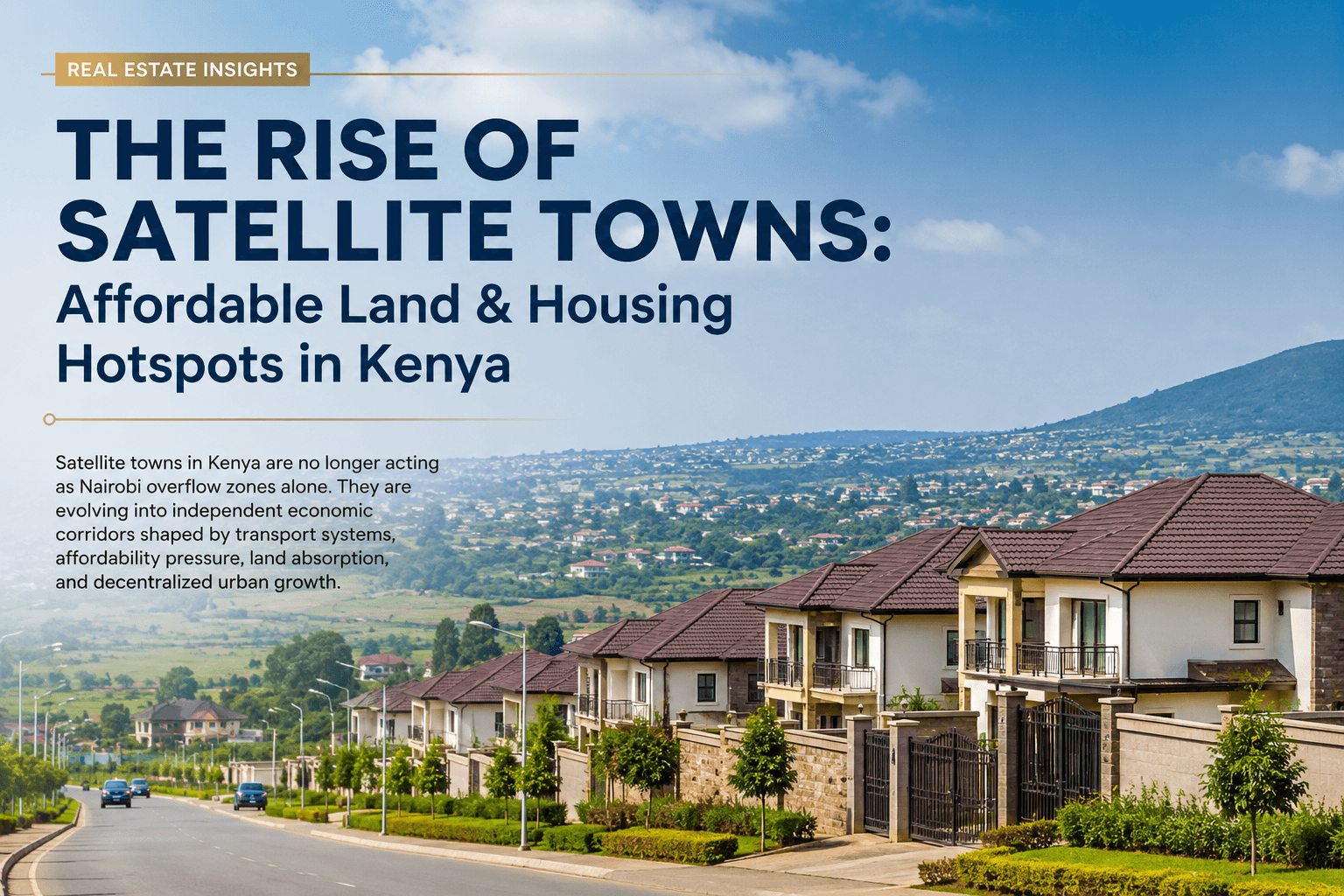
The Rise of Satellite Towns: Affordable Land & Housing Hotspots in Kenya

Kenya’s satellite towns are no longer behaving like temporary urban spillover zones. They are gradually evolving into independent economic ecosystems shaped by land affordability, infrastructure expansion, population migration, and decentralized urban activity.
For years, many satellite towns existed primarily as commuter settlements orbiting Nairobi. That dynamic is changing.
Today, towns such as Ruiru, Juja, Kitengela, Athi River, Ngong, Kamulu, and Syokimau are increasingly developing their own commercial identities, residential demand systems, and internal economic activity.
The shift is structural, not temporary.
Why Satellite Towns Are Expanding So Aggressively
Urban cores eventually encounter pressure limits.
As cities become denser, three things typically happen simultaneously:
- Land prices rise rapidly
- Housing affordability weakens
- Transport congestion intensifies
This creates outward migration pressure.
Households and developers begin searching for areas where:
- Land remains affordable
- Development costs are lower
- Transport access remains viable
- Future appreciation potential exists
Satellite towns absorb this pressure.
But over time, repeated migration and investment gradually transform these towns into self-sustaining urban nodes.
The Most Important Driver Is Not Land Price — It Is Accessibility
Many people assume satellite towns grow simply because land is cheaper.
That explanation is incomplete.
Cheap land alone does not create sustainable urban growth.
The true catalyst is accessibility.
A satellite town becomes economically viable when people can maintain economic participation while living outside the expensive urban core.
This means infrastructure matters more than most investors initially realize.
| Growth Driver | Why It Matters |
|---|---|
| Road Connectivity | Reduces commuting friction |
| Public Transport Access | Maintains labor mobility |
| Utility Expansion | Supports long-term settlement |
| Commercial Activity | Creates localized economies |
| Land Availability | Allows scalable development |
The strongest satellite towns are usually the ones where movement efficiency improves faster than congestion growth.
Satellite Towns Are Quietly Redefining Urban Geography
Historically, Nairobi operated as the dominant economic center while surrounding areas functioned as dependent residential zones.
That model is weakening.
Satellite towns are increasingly creating their own:
- Retail systems
- Education clusters
- Logistics activity
- Industrial corridors
- Residential demand cycles
This creates a powerful transformation.
Instead of one central city with peripheral support towns, Kenya is gradually moving toward a distributed urban network.
That changes real estate investment logic entirely.
A New Development Concept: Corridor Urbanization Theory
Most real estate analysis still views satellite towns individually.
But a more accurate framework may be corridor-based urbanization.
Proposed Concept: Corridor Urbanization
Under this model, growth does not occur randomly across isolated towns.
Instead, urban expansion concentrates along movement corridors where:
- Transport systems improve
- Commercial movement increases
- Labor mobility remains efficient
- Land remains developable
The corridor itself becomes the economic engine.
Towns positioned along strong corridors compound each other’s growth.
Tested Conceptual Hypothesis
Hypothesis: Satellite towns located along high-mobility infrastructure corridors will experience stronger long-term real estate absorption and commercial diversification than towns growing in isolation from major movement systems.
Conceptual Testing Logic
Scenario A — Isolated Town Growth
- Growth depends heavily on speculative land buying
- Economic activity remains fragmented
- Employment dependency stays external
- Urban momentum weakens during slowdowns
Scenario B — Corridor-Based Growth
- Transport movement continuously reinforces activity
- Commercial systems emerge organically
- Population retention improves
- Land absorption remains more consistent
The logical conclusion suggests that movement systems shape urban durability more than isolated land affordability alone.
Why Developers Are Prioritizing Satellite Towns
Satellite towns provide something increasingly difficult to find inside major urban cores:
Scalable development flexibility.
Developers benefit from:
- Larger parcel availability
- Lower acquisition costs
- Reduced density constraints
- Phased project expansion opportunities
This allows housing developers to experiment with:
- Master-planned communities
- Mixed-use developments
- Affordable housing systems
- Rental-focused projects
Urban cores often lack this flexibility due to fragmentation and pricing pressure.
The Hidden Economic Shift Most Investors Miss
Satellite towns are not simply absorbing residents.
They are redistributing economic gravity.
As populations grow, businesses naturally follow:
- Retail centers emerge
- Private schools expand
- Warehousing demand rises
- Health facilities increase
- Hospitality activity develops
Over time, economic dependency on the primary city weakens.
This creates localized economic ecosystems capable of sustaining independent growth cycles.
The Risk Behind Speculative Land Buying
Not every satellite town succeeds equally.
Some locations experience speculative hype without structural economic support.
This creates several risks:
| Risk Area | Potential Outcome |
|---|---|
| Weak infrastructure | Slow settlement growth |
| Poor transport access | Low occupancy demand |
| Speculative oversupply | Stagnant appreciation |
| Unplanned development | Future congestion problems |
| Utility instability | Reduced livability |
Land appreciation alone does not create sustainable urban systems.
Real urban durability requires economic reinforcement.
The Psychology Behind Satellite Town Migration
Housing decisions are rarely purely financial.
People increasingly prioritize:
- Space
- Mobility
- Lower living pressure
- Perceived lifestyle improvement
Satellite towns often offer:
- Larger living environments
- Reduced density pressure
- Emerging gated communities
- More flexible ownership pathways
This creates a psychological migration effect where households trade centrality for livability.
The Future of Kenya’s Urban Expansion
Kenya’s future urban growth may not revolve around one dominant city center.
Instead, the country appears to be gradually transitioning toward interconnected urban corridors supported by transport systems and distributed economic activity.
This has major implications for:
- Land investment strategy
- Housing development
- Commercial property demand
- Infrastructure allocation
The next phase of real estate growth may belong less to isolated urban centers and more to integrated movement corridors.
Final Conclusion
Satellite towns in Kenya are evolving into something larger than commuter settlements.
They are becoming decentralized economic ecosystems shaped by mobility, affordability, infrastructure expansion, and demographic migration.
The strongest insight is this:
Urban growth follows movement efficiency before it follows prestige.
The proposed Corridor Urbanization framework suggests that towns connected through efficient transport and economic movement systems may outperform isolated speculative zones over the long term.
For investors, developers, and planners, the opportunity is no longer simply acquiring cheap land.
It is identifying where future economic movement will concentrate.
Frequently Asked Questions
1. Why are satellite towns growing so quickly in Kenya?
Because rising urban costs, transport expansion, and housing demand are pushing population growth outward from major city centers.
2. What makes a satellite town successful long term?
Accessibility, infrastructure reliability, commercial activity, and economic integration matter more than cheap land alone.
3. What is Corridor Urbanization?
It is a proposed framework suggesting that urban growth concentrates along high-mobility infrastructure corridors rather than isolated towns developing independently.
4. Are satellite towns good for land investment?
Some are. The strongest opportunities usually emerge where transport connectivity, utility systems, and economic activity reinforce long-term settlement growth.
5. What is the biggest risk when buying land in satellite towns?
Speculative buying without supporting infrastructure or long-term economic activity can result in slow appreciation and weak demand absorption.
Disclaimer: This article is for informational purposes only and does not constitute investment, legal, or financial advice.
Filed under
Related Reading