Global Property & Capital Markets
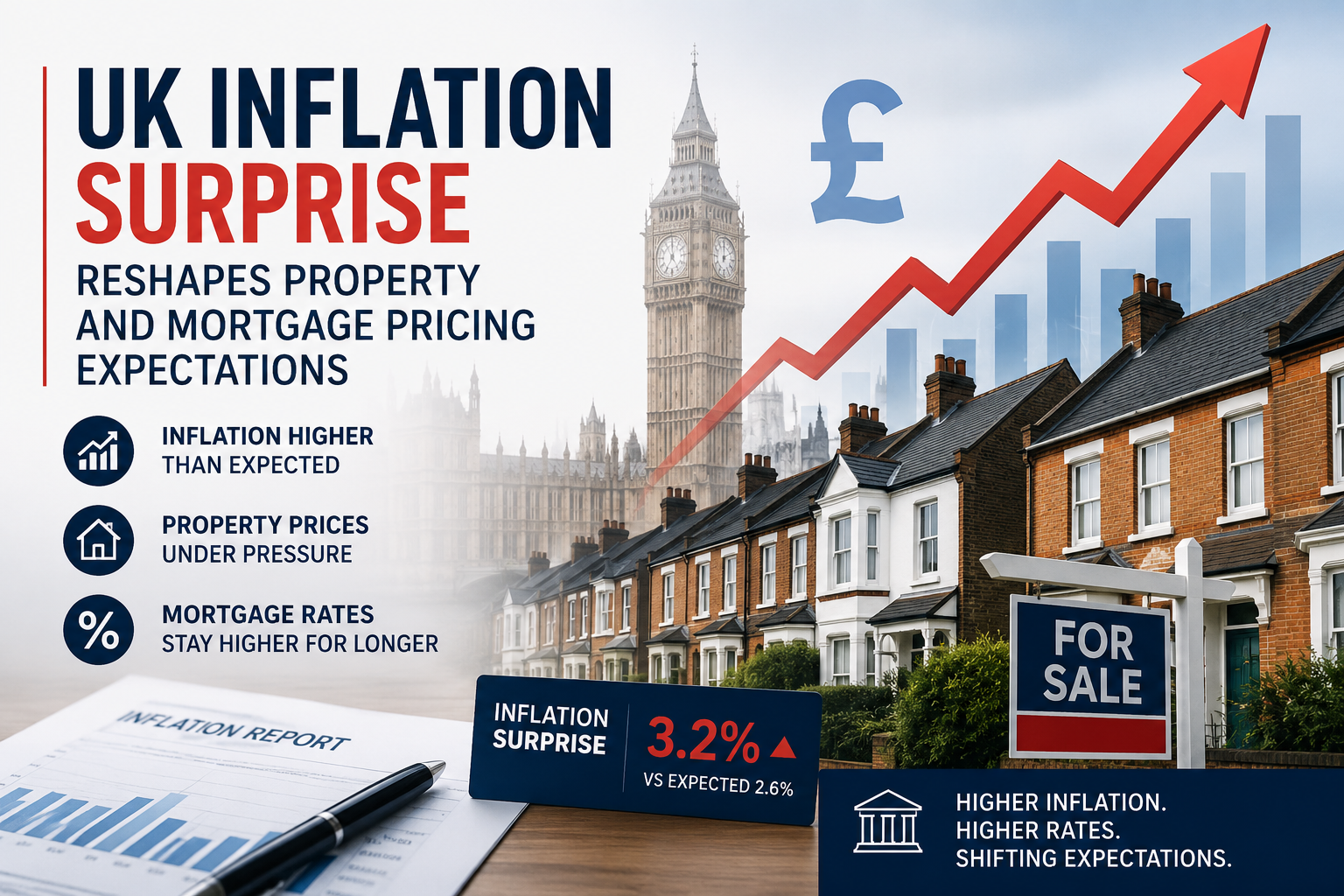
UK Inflation Surprise Reshapes Property and Mortgage Pricing Expectations
UK Inflation Surprise Reshapes Property and Mortgage Pricing Expectations
commercial skyline and UK inflation market reaction in 2026">
UK inflation unexpectedly fell to 2.8% in May 2026 against market expectations that pricing pressure would remain elevated. The reaction across the property industry was immediate. Mortgage markets interpreted the data as early evidence that financing conditions may stabilise faster than previously anticipated, even as geopolitical instability and energy market volatility continue distorting long-duration interest rate expectations.
The significance extends beyond residential borrowing costs. Inflation moderation directly influences institutional property pricing, debt availability, refinancing conditions, and yield behaviour across the UK commercial real estate market. For investors allocating capital into London offices, logistics assets, and income-producing residential portfolios, the question is no longer whether inflation remains elevated. The question is whether the Bank of England can sustain policy easing without reigniting pricing pressure later in the cycle.
Why Inflation Moderation Matters for Property Markets
Property markets are fundamentally interest-rate transmission mechanisms.
When inflation accelerates, central banks tighten monetary policy to slow economic activity. Financing costs rise. Mortgage affordability deteriorates. Commercial property yield spreads compress under pressure from higher debt servicing assumptions and weaker acquisition activity.
That dynamic defined much of the UK property cycle throughout 2024 and 2025. Fixed mortgage pricing rose sharply as investors adjusted expectations around how long elevated interest rates would persist. Several institutional buyers paused acquisitions entirely while repricing assumptions around debt costs and stabilised net operating income.
The latest inflation reading alters sentiment, at least temporarily.
Mortgage Advice Bureau noted that many prospective buyers had been waiting for a macroeconomic signal before re-entering the market. Inflation easing to 2.8% potentially provides that signal, particularly if lenders continue reducing fixed-rate products over the coming months.
Mortgage Pricing Is Already Reacting
Fixed-rate mortgage markets tend to react before central bank policy formally changes.
Several lenders had already begun trimming rates prior to the inflation announcement as bond markets gradually priced lower medium-term inflation expectations. Recent remortgage tracking data showed average leading two-year fixed products easing below levels seen during the previous month’s volatility spike.
The decline matters because transaction velocity across both residential and mixed-use property markets had slowed materially under affordability pressure. Buyers increasingly delayed decisions while waiting for clearer guidance around rate direction and inflation stability.
Yet markets remain cautious.
The conflict involving Iran continues creating broader energy and commodities uncertainty. Institutional investors understand that inflation shocks tied to oil prices or supply chain disruption can rapidly reverse monetary easing assumptions. This partly explains why long-duration bond yields remain relatively elevated despite softer headline inflation.
The Disconnect Between Inflation and Property Optimism
Lower inflation does not automatically translate into a stronger property cycle.
Structural affordability pressures remain significant across much of the United Kingdom, particularly within London and the South East. Real household income growth remains uneven, refinancing costs are still materially higher than pre-2022 levels, and several office markets continue adjusting to hybrid working demand patterns.
Consider the institutional office segment specifically.
Prime office assets with strong ESG positioning and modern infrastructure continue attracting capital despite broader sector uncertainty. Secondary office inventory, however, remains vulnerable to refinancing risk, weaker tenant demand, and potential value erosion if interest rates stay elevated longer than expected.
Inflation moderation helps pricing sentiment. It does not remove structural inefficiencies already embedded within several UK property sectors.
What Institutional Investors Are Watching Now
Sophisticated allocators are now focusing less on headline inflation and more on policy durability.
The Bank of England’s 2% target remains above current inflation readings, but investors understand that central banks rarely pivot aggressively while geopolitical risk remains elevated. Markets are therefore assessing whether inflation can sustainably remain below 3% without triggering renewed wage pressure or imported inflation through energy markets.
This creates an unusual pricing environment.
Debt markets are cautiously improving while investor confidence remains selective. Capital increasingly concentrates toward high-quality logistics assets, infrastructure-linked industrial property, and prime mixed-use developments with resilient tenant profiles.
In London specifically, institutional investors continue prioritising buildings capable of sustaining occupancy durability under slower economic growth conditions. Assets dependent entirely on speculative rental growth assumptions remain significantly harder to finance.
 commercial property and inflation-linked capital markets transition"
>
commercial property and inflation-linked capital markets transition"
>
The Bank of England Faces a Delicate Position
Inflation may be easing, but monetary policy credibility remains central.
Premature rate reductions risk reigniting inflation expectations, particularly if geopolitical instability disrupts energy pricing or supply chains. Yet maintaining restrictive financing conditions for too long could deepen affordability stress across residential markets while increasing refinancing pressure across commercial assets.
This tension increasingly defines the next phase of the UK property cycle.
Markets are no longer debating whether inflation peaked. They are debating whether the disinflation process is durable enough to support long-term repricing across property and credit markets.
Portfolio Strategy Takeaway
The inflation decline to 2.8% improves market sentiment, but institutional investors remain focused on durability rather than short-term optimism. Financing conditions are stabilising gradually, not resetting aggressively.
For property investors, the most resilient positioning continues concentrating around high-quality income-producing assets with strong tenant fundamentals, infrastructure connectivity, and refinancing resilience. The next phase of the UK property cycle will likely reward operational durability more than speculative appreciation assumptions.
Frequently Asked Questions
Why did UK inflation falling to 2.8% matter for property markets?
Lower inflation potentially reduces pressure on interest rates and mortgage pricing, improving affordability conditions and supporting transaction activity across residential and commercial property markets.
Will UK mortgage rates now decline significantly?
Mortgage rates may gradually ease if inflation continues slowing, although geopolitical risks and global energy volatility could still keep borrowing costs elevated.
How are institutional investors interpreting the inflation data?
Institutional investors increasingly view inflation moderation as supportive for pricing stability, but remain cautious regarding long-term rate expectations and macroeconomic uncertainty.
What sectors of UK property are most sensitive to inflation changes?
Office, residential, logistics, and income-producing commercial assets are particularly sensitive to inflation expectations because financing costs directly influence pricing, yield spreads, and investor demand.
Disclaimer: This article is for informational purposes only and does not constitute investment advice. Murivest Realty Group Ltd is an independent real estate advisory and research firm. We do not offer regulated financial products or collective investment schemes. All market commentary reflects publicly available information, macroeconomic interpretation, and institutional property analysis at the time of publication. Investors should undertake independent legal, financial, and commercial due diligence before making acquisition or allocation decisions. Property markets involve risk, including potential capital loss, financing exposure, and macroeconomic volatility.
Filed under
Related Reading
Murivest Community
Investor Discussion
Discuss investment opportunities, market trends, lease activity, financing, and underwriting with the Murivest community.
Join the Discussion
Share investment insights, market commentary, or leasing observations.
Professional discussion only. All comments are moderated.
Loading…
No discussion yet — be the first to contribute an insight.
Ask Murivest Research
Submit a Research Question
Questions on underwriting, leasing, market fundamentals, or capital structures are answered by the Murivest desk.
Murivest Research